OpenAI DevDay 2026 puts software vendors in an uncomfortable spot: compete with ChatGPT for the daily user interface, or plug into it for distribution. The same platform that lowers your infrastructure costs can simultaneously swallow your workflow and make your standalone product harder to sell.
For years, software founders operated under a comfortable division of labor: OpenAI provided raw model intelligence via API tokens, while vendors added specialized UX, proprietary context, and workflow logic. OpenAI was the utility company; you owned the customer.
DevDay 2026 ends that arrangement. OpenAI is moving directly into the daily workspace where teams collaborate, write code, run tasks, and make operational decisions.
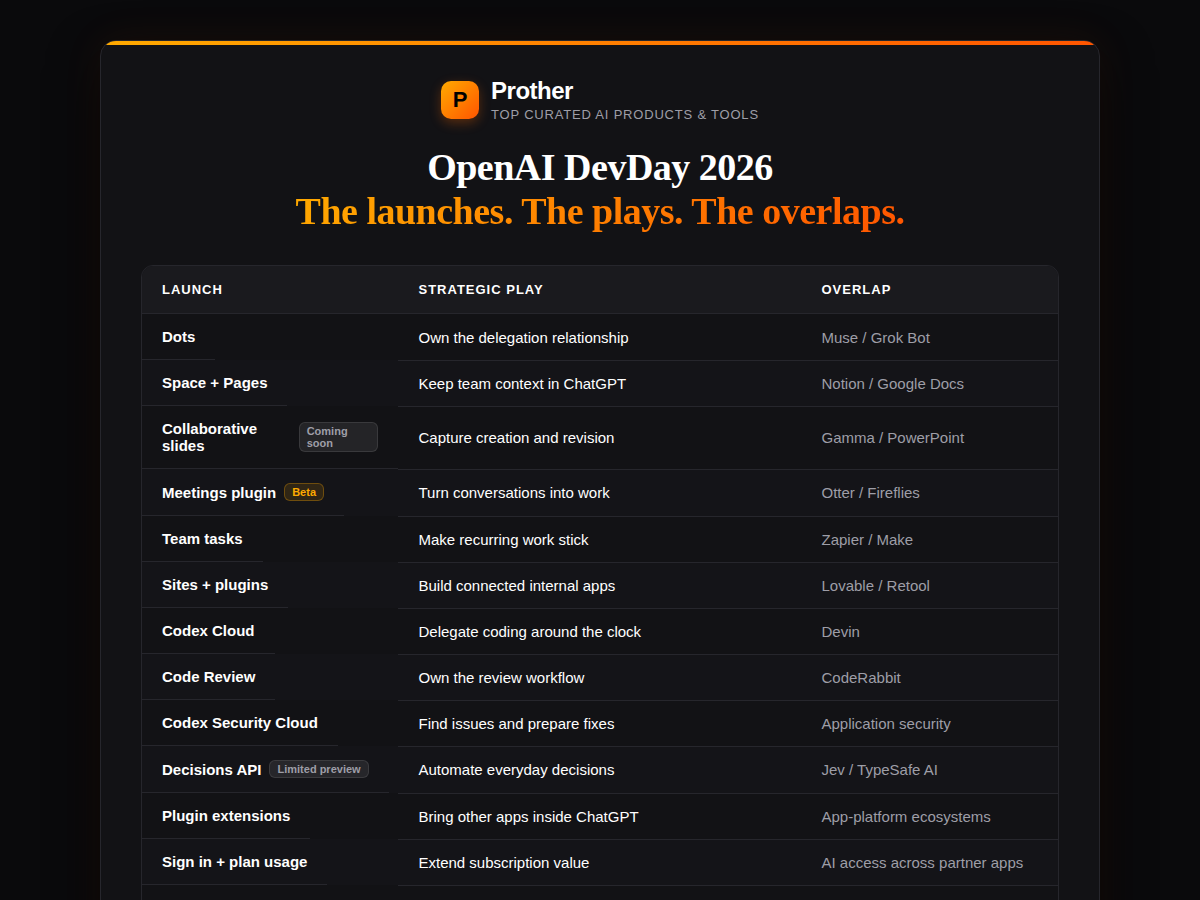
The OpenAI DevDay 2026 Launch Matrix
Below is how the newest product launches line up against existing SaaS categories:
| Launch | Strategic Play | Overlap & Competing Tools |
|---|---|---|
| Dots | Own the delegation and agent relationship | Grok Bot, Muse |
| Space + Pages | Keep team knowledge and docs inside ChatGPT | Notion AI, Google Docs |
| Collaborative slides (Coming soon) | Capture deck generation and editing | Gamma, Beautiful.ai |
| Meetings plugin (Beta) | Convert live conversations into automated action | Otter.ai, Fireflies |
| Team tasks | Automate recurring background jobs | Zapier, Make |
| Sites + plugins | Build and host connected internal tooling | Lovable, Retool |
| Codex Cloud | Delegate autonomous coding around the clock | Devin, Cursor, Windsurf |
| Code Review | Own the pull request analysis workflow | CodeRabbit, GitHub Copilot |
| Codex Security Cloud | Detect vulnerabilities and stage automated patches | Snyk, Application Security |
| Decisions API (Preview) | Automate operational rules and approvals | Jev, TypeSafe AI |
| Plugin extensions | Embed third-party services inside ChatGPT | Platform App Stores |
| Sign in + plan usage | Extend subscription credit across external apps | Partner SSO & AI Access |
| OpenAI Marketplace | Tie partner spend to enterprise commitments | Cloud Marketplaces (AWS, GCP) |
The Workflow Squeeze: When ChatGPT Becomes the Operating System
When a platform swallows the user interface, standalone tools lose their justification as separate browser tabs. The DevDay 2026 roster systematically targets core categories across modern knowledge work:
- Team Context and Workspace Docs: Products like Space + Pages move collaborative documentation directly into ChatGPT, competing with Notion AI and Google Docs. Collaborative slides captures presentation generation, challenging Gamma and PowerPoint.
- Meeting Intelligence and Task Automation: The Meetings plugin transcribes and summarizes calls in real time, competing with Otter.ai. Team tasks handles multi-step scheduled jobs, stepping squarely into territory held by Zapier and Make.
- Internal Tooling: Sites + plugins lets non-technical operators generate and deploy internal web tools inside ChatGPT, challenging low-code builders like Retool.
- Developer Workflows: Codex Cloud delegates software tasks around the clock (competing with Devin), while native Code Review and Codex Security Cloud pull pull-request analysis and vulnerability patching into OpenAI default ecosystem.
- Decision Automation: The Decisions API handles routine operational routing, competing with niche decision engines.
When an employee already keeps ChatGPT open as their central thinking workspace, opening a third-party app creates friction. Switching tabs requires copy-pasting context that ChatGPT already possesses.
The Partner Paradox: Distribution with a Leash
To soften this encroachment, OpenAI is offering vendors a carrot: massive distribution.
Features like Plugin extensions, Sign in + plan usage, and the OpenAI Marketplace offer an enticing trade-off. By building on OpenAI extension framework, software companies can place their tools directly inside ChatGPT. Customers can authenticate using their existing OpenAI enterprise commitments, bypassing procurement delays and exposing products to millions of active teams.
Yet this distribution model creates three structural risks:
- Loss of Relationship Ownership: When users trigger your service via a ChatGPT prompt, OpenAI controls the UI layout, the interaction pattern, and the session context. You become a headless compute worker behind someone else interface.
- Pricing and Margin Compression: The OpenAI Marketplace ties third-party revenue to OpenAI enterprise commitments. As IT departments consolidate software spend into centralized AI credits, partner vendors face mounting pressure to discount their margins to fit into the bundle.
- The Feature Absorption Cycle: Any partner extension that proves broadly useful becomes the primary candidate for a native feature in next year keynote.
Partnering with ChatGPT solves day-one distribution, but it risks turning your software into an anonymous backend feature of someone else operating system.
How Software Vendors Must Respond: 3 Strategic Rules
Software companies cannot afford to boycott OpenAI, nor can they survive by building thin wrappers around public models. Long-term defensibility requires shifting value away from vulnerable surface layers.
1. Shift Moats from Interface Convenience to Systems of Record
If your product core value is a clean dashboard or a streamlined form, ChatGPT will eventually absorb it. Sustainable defensibility requires owning proprietary data, complex system-of-record state, domain-specific compliance, or deep enterprise integrations that a conversational shell cannot easily replace.
2. Treat ChatGPT as a Distribution Channel, Not an Existential Enemy
For many specialized tools, treating ChatGPT as an acquisition channel is the pragmatic choice. By exposing APIs through Plugin extensions and the Decisions API, vendors can capture high-intent usage where users already work. The requirement is ensuring that while ChatGPT renders the front end, your proprietary backend remains indispensable.
3. Focus on Deep, Vertical Workflows
Horizontal AI platforms excel at generalist tasks: drafting emails, summarizing meetings, and writing generic boilerplate code. They struggle with deep, industry-specific workflows that demand rigorous compliance audit trails, complex multi-step validations, or specialized hardware connections. Deep vertical specialization remains the strongest defense against horizontal platform expansion.
The Bottom Line for Software in 2026
OpenAI DevDay 2026 clarifies the next phase of the software market. OpenAI is no longer merely an API provider: it is actively building the enterprise operating system.
Software companies that rely solely on workflow convenience will see their pricing power erode as ChatGPT absorbs their interfaces. The winners of this cycle will be builders who own deep domain data and essential system state, utilizing OpenAI for reach while retaining control over their foundational value.